
We’ve all been there. You see a “specialized” garlic peeler or a plastic “pot-clip” on social media, and suddenly your kitchen drawer is so full of gadgets you can’t even close it.
Last year, I decided to declutter. I realized that the most expensive gadgets were often the least useful. Meanwhile, my simple wooden spoon—the one that cost me $2 and has been in my drawer for years—was doing more work than all the plastic “as-seen-on-TV” junk combined.
Here are 5 kitchen hacks with a wooden spoon that solve everyday problems, plus the science of why they actually work.
5 Genius Kitchen Hacks With a Wooden Spoon
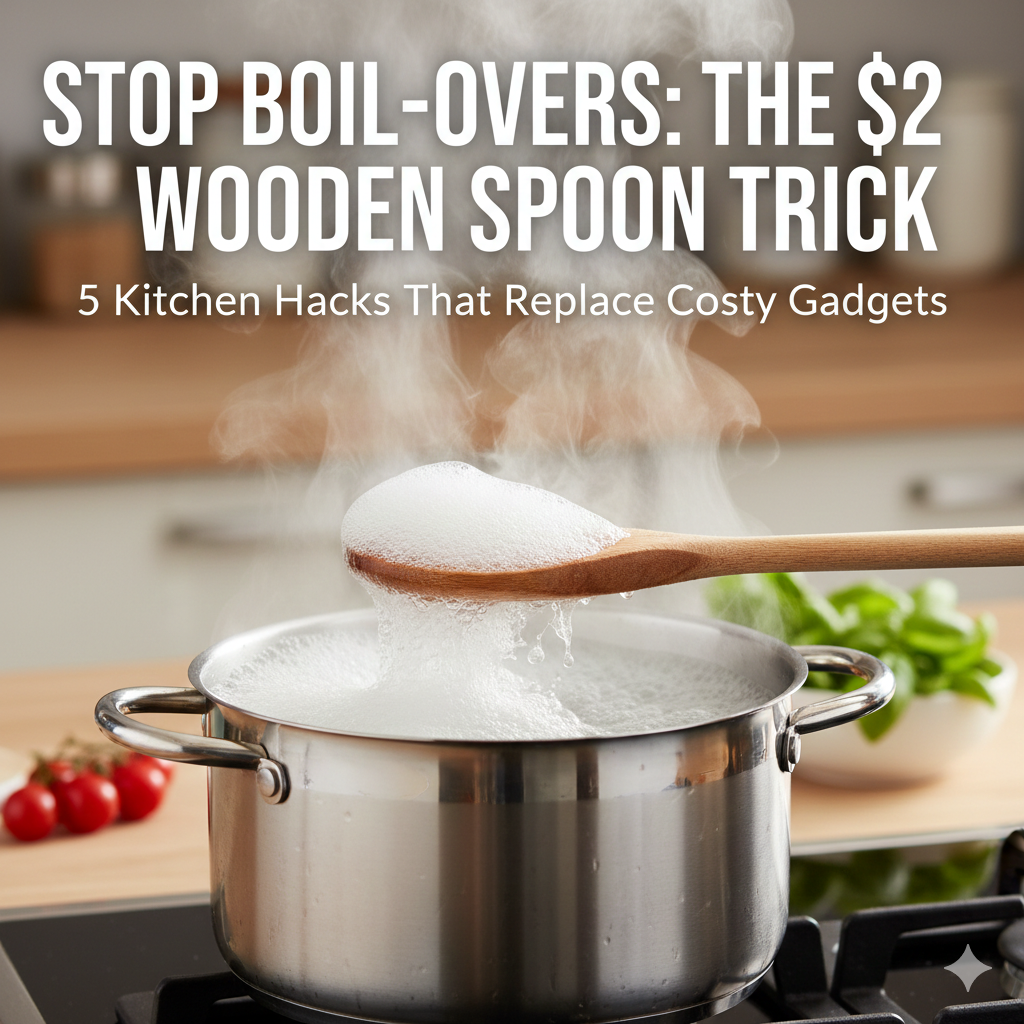
1. The “Anti-Mess” Boil-Over Guard
If you’ve ever walked away from a pot of pasta for ten seconds only to return to a starchy, bubbly disaster on your stovetop, this is for you.
-
The Hack: Lay your wooden spoon flat across the top of the boiling pot.
-
The Experience: I’ve tested this with potatoes, pasta, and rice. The bubbles hit the wood, and because wood is cooler and breaks surface tension, the foam retreats. It’s like a “reset button” for your stove.
Does a wooden spoon really stop water from boiling over?
Yes, placing a wooden spoon across a boiling pot prevents boil-overs because the wood acts as a natural insulator that breaks the surface tension of the bubbles. Since wood is hydrophobic and stays cooler than the boiling liquid, it forces the steam bubbles to collapse as soon as they make contact.
2. The DIY “Oil Temperature Test.”
Don’t have a fancy laser thermometer to see if your oil is ready for frying? Use the handle of your spoon.
-
The Hack: Dip the end of the wooden spoon handle into the heating oil.
-
The Sign: If tiny bubbles start to form around the wood and float up, your oil is ready. If it bubbles violently, it’s too hot.
How do you check oil temperature with a wooden spoon?
To check if oil is ready for frying, insert the handle of a wooden spoon into the oil; if steady bubbles form around the wood, the oil is at the ideal temperature (approx. 325-350°F). If the oil doesn’t bubble, it is too cold, and if it bubbles aggressively, the oil is too hot and should be cooled down.
3. The “Perfect Rice” Steam Vent
Getting the right texture for rice is a battle of moisture.
-
The Hack: If your rice lid doesn’t have a vent, prop it open just a crack by wedging the thin part of the spoon handle between the pot and the lid.
-
Why it works: It allows a steady stream of excess steam to escape without losing all the heat, preventing “mushy rice” syndrome.
4. The Quick-Clean Pasta Measurer
Did you know the hole in the middle of some wooden spoons isn’t just for hanging it up?
-
The Hack: On many standard spoons, the center hole is designed to measure exactly one serving size of dry spaghetti.
-
Trust Tip: I actually measured this against a kitchen scale. While it varies by brand, it’s surprisingly accurate for a single serving!
5. The “No-Slip” Freezer Defroster
Sometimes the simplest use is purely ergonomic.
-
The Hack: Use the blunt end of the handle to chip away at ice buildup in an old freezer gently.
-
Experience: It’s much safer than using a knife. I’ve used this to “pry” apart frozen burger patties without the risk of a sharp blade slipping.
Why Wood? (The Authority Bit)
I did some digging into why we don’t use metal or plastic for these hacks. Wood is a natural insulator. It doesn’t conduct heat quickly, which is why it breaks bubbles without melting or getting too hot to touch. It’s also “hydrophobic,” meaning it naturally repels the water in the bubbles, forcing them to pop.
A Quick Word of Caution
Because I want you to stay safe: Never leave a wooden spoon over a high gas flame. Wood is, well, wood—it can char if the flames lick up the side of the pot. Always keep the handle pointed away from the direct heat source.