
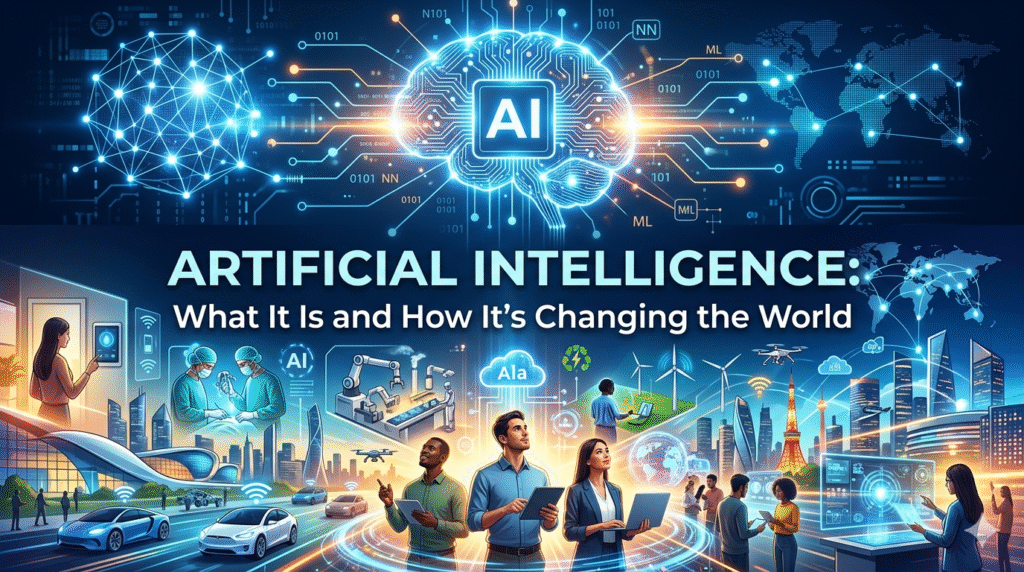
Introduction: The AI Revolution is Here
We are living in the age of Artificial Intelligence. From the smartphone in your pocket to the recommendation algorithms on Netflix, AI has become an invisible force shaping our digital experiences and, increasingly, our physical world.
The question is no longer “Will AI change our world?” but rather “How much will it change?” In this comprehensive guide, we’ll explore what artificial intelligence truly is, demystify how it works, and examine its profound impact on business, healthcare, education, science, and society at large.
What is Artificial Intelligence? A Clear Definition
Artificial Intelligence (AI) refers to computer systems designed to perform tasks that typically require human intelligence. These tasks include visual perception, speech recognition, decision-making, language translation, pattern recognition, and even creative thinking.
In simpler terms: AI is technology that learns from data, identifies patterns, and makes decisions or predictions based on that learning, often with minimal human intervention.
The Core Distinction
Traditional software follows explicit instructions written by programmers. AI systems, however, learn from examples and improve over time without being explicitly programmed for every scenario. This fundamental difference is what makes AI revolutionary.
How Does AI Actually Work? Breaking Down the Process
1. Data Collection and Preparation
Every AI system starts with data. This could be images, text, numbers, audio, or any information relevant to the task. The quality and quantity of data directly affect AI performance. Garbage in, garbage out—as the saying goes.
2. Machine Learning: Teaching the Machine
Machine Learning (ML) is a subset of AI where systems learn patterns from data without explicit programming. Think of it like teaching a child by showing examples:
- Show thousands of cat images to an AI system
- Tell the system, “This is a cat.”
- The system identifies patterns that make a cat a cat
- When shown a new image, it can recognize if it’s a cat or not
3. Neural Networks and Deep Learning
Deep Learning uses artificial neural networks—inspired by how the human brain works. These networks have multiple layers (hence “deep”) that process information:
- Input Layer: Receives raw data
- Hidden Layers: Process and transform data
- Output Layer: Produces the final decision or prediction
Each layer learns increasingly abstract features. In image recognition, early layers might detect edges and colors, while deeper layers recognize eyes, noses, or complete faces.
4. Training and Optimization
During training, the AI system makes predictions and compares them to the correct answers. When it’s wrong, algorithms adjust the network’s parameters to improve future predictions. This happens thousands or millions of times until accuracy reaches the desired levels.
5. Deployment and Continuous Improvement
Once trained, the AI system is deployed to handle real-world tasks. Many modern AI systems continue learning from new data, improving their accuracy over time.
Types of AI: From Narrow to General AI
Narrow AI (Weak AI)
This is every AI system currently in use. Narrow AI is designed for specific tasks and cannot perform outside its defined scope. Examples include:
- Chess engines that can only play chess
- Image recognition systems for medical diagnosis
- Natural Language Processing (chatbots like ChatGPT)
- Recommendation algorithms (Netflix, Spotify)
Current Status: Highly advanced and increasingly capable within their domains.
General AI (Strong AI)
This is theoretical AI that could understand and perform any intellectual task a human can. It would have consciousness, self-awareness, and the ability to learn and apply knowledge across different domains.
Current Status: Does not exist yet. Experts disagree on when (or if) it will be achieved. Estimates range from decades to centuries away.
Super AI (ASI – Artificial Super Intelligence)
Theoretical AI that surpasses human intelligence across all domains. It would be exponentially smarter than the best human minds.
Current Status: Purely speculative. Major focus of AI ethics and safety research.
| Type of AI | Definition | Examples | Status |
|---|---|---|---|
| Narrow AI | AI for specific tasks | ChatGPT, image recognition, recommendation engines | Exists today |
| General AI | AI with human-level intelligence across domains | None (theoretical) | Hypothetical |
| Super AI | AI surpassing human intelligence | None (theoretical) | Speculative |
Real-World Applications of AI You Use Every Day
Virtual Assistants
Siri, Alexa, Google Assistant, and Cortana use Natural Language Processing (NLP) to understand spoken or written commands and provide relevant responses. They’re getting smarter at understanding context and nuance.
Social Media Feeds
Instagram, Facebook, TikTok, and YouTube use AI algorithms to curate personalized feeds. These algorithms analyze your behavior, interests, and engagement patterns to predict what you want to see next.
Email Spam Filters
Gmail, Outlook, and other email providers use machine learning to identify and filter spam emails with over 99% accuracy, protecting you from phishing and malicious content.
Streaming Services
Netflix uses AI to recommend shows and movies. Amazon Prime, Disney+, and Spotify employ similar recommendation systems that improve the more you use them.
Facial Recognition
Smartphones unlock with your face. Airports use facial recognition for border control. Social media platforms use it to tag people in photos. Law enforcement uses it for identification.
Autonomous Vehicles
Self-driving cars use computer vision, sensor fusion, and neural networks to perceive their environment and make driving decisions in real-time.
Medical Diagnosis
AI systems can detect cancer, heart disease, and other conditions from medical images (X-rays, MRIs, CT scans), often with accuracy equal to or exceeding that of experienced doctors.
How AI is Transforming Key Industries
Healthcare
AI is revolutionizing medicine through drug discovery, personalized treatment plans, predictive diagnostics, and surgical robotics. IBM Watson, for example, assists oncologists in cancer treatment recommendations.
Finance and Banking
Financial institutions use AI for fraud detection, algorithmic trading, credit assessment, and customer service. AI processes millions of transactions daily, identifying suspicious patterns instantly.
Manufacturing
AI-powered robots and computer vision systems improve quality control, reduce defects, and optimize production lines. Predictive maintenance prevents costly equipment failures.
Retail and E-commerce
AI personalizes shopping experiences, predicts inventory needs, optimizes pricing, and powers checkout-free stores. Amazon’s Just Walk Out technology uses computer vision and sensor fusion.
Agriculture
AI helps farmers maximize crop yields through precision agriculture. Drones with computer vision detect crop diseases early. Predictive analytics optimize irrigation and fertilizer use.
Education
Adaptive learning platforms use AI to personalize education. Virtual tutoring systems provide immediate feedback. AI helps identify students who need additional support.
Benefits and Opportunities of AI
- Increased Efficiency: Automation handles repetitive tasks, freeing humans for creative and strategic work
- Better Decision Making: AI analyzes vast datasets, uncovering patterns humans might miss
- Cost Reduction: Automating processes reduces operational costs significantly
- 24/7 Availability: AI systems work continuously without fatigue or breaks
- Personalization at Scale: AI customizes experiences for millions of users simultaneously
- New Discoveries: AI accelerates scientific research, medical breakthroughs, and innovation
- Enhanced Safety: AI identifies risks, prevents accidents, and improves security
- Accessibility: AI powers tools that help people with disabilities (speech recognition, image description)
Challenges and Concerns About AI
Job Displacement
Automation threatens jobs in data entry, customer service, manufacturing, and transportation. However, history shows technology creates new jobs while eliminating old ones, though the transition can be difficult.
Bias and Fairness
AI systems learn from historical data, which may contain human biases. If trained on biased data, AI can perpetuate or amplify discrimination in hiring, lending, criminal justice, and healthcare.
Privacy Concerns
AI requires vast amounts of data. This raises questions about data collection, storage, and who has access to personal information.
Lack of Transparency
Deep learning models are often “black boxes”—we know what goes in and what comes out, but not exactly how the system reaches its conclusions. This is problematic for high-stakes decisions (medical diagnosis, loan approval, criminal sentencing).
Security and Misuse
Powerful AI systems can be misused for deepfakes, cyberattacks, surveillance, or autonomous weapons. Security is a critical concern.
Dependence and Loss of Skills
Over-reliance on AI could cause humans to lose critical skills. If we rely on GPS, do we still know how to navigate? If we rely on spell-check, do we still know how to spell?
The Future of AI: What Lies Ahead
Near-Term (2026-2030): Rapid Advancement
- AI becomes more multimodal (understanding text, images, audio, and video simultaneously)
- AI achieves human-level performance in more specific domains
- Explainability improves—we understand AI decisions better
- AI regulation becomes standardized globally
Medium-Term (2030-2040): Integration and Transformation
- AI becomes commonplace in most industries
- Major workforce transitions occur—new jobs created, old ones eliminated
- AI contributes significantly to scientific breakthroughs
- Questions about AI rights and consciousness become more serious
Long-Term (2040+): Uncertain Territory
- Possibility of Artificial General Intelligence (AGI)
- Society-wide transformation in work, education, and human purpose
- Fundamental questions about the human-AI relationship answered
- Either a utopian or dystopian future—preparation matters immensely
Key Trends to Watch
Quantum Computing: When quantum computers mature, they could dramatically accelerate AI capabilities—and potentially break current security systems.
AI Regulation: Governments worldwide are developing AI regulation frameworks. The EU’s AI Act is already implemented; others are following.
AI Ethics: Growing focus on responsible AI, fairness, transparency, and human oversight.
Conclusion: Preparing for the AI-Powered Future
Artificial Intelligence is not a distant future technology—it’s transforming our world right now. From healthcare to finance, from education to entertainment, AI is becoming woven into the fabric of society.
The key to thriving in an AI-driven world is understanding it. This article has provided a foundation: what AI is, how it works, where it’s being applied, and where it’s heading.
But understanding AI is just the beginning. We must also:
- Develop AI literacy: Everyone should understand basic AI concepts
- Demand ethical AI: Support fair, transparent, and accountable AI systems
- Adapt professionally: Continuously learn skills that complement AI
- Engage in dialogue: Participate in conversations about AI’s societal impact
- Stay informed: Keep learning as AI technology evolves
The future isn’t something that happens to us—it’s something we create. By understanding AI today, we’re better equipped to shape a future where technology serves humanity’s best interests.
Want to dive deeper into AI? Subscribe to Ilmi Duniya’s newsletter for regular updates on technology, science, and innovation. Join thousands of curious minds exploring the world of knowledge.